

Gutter Overflow and Basement Flooding in Richmond, VA
How an overflowing gutter turns into water in your basement, why your insurance may not cover it, and what actually stops it.
The Short Answer
When gutters overflow or downspouts discharge too close to the foundation, they create localized flooding right around your basement’s most vulnerable point: window wells and foundation walls. That water builds hydrostatic pressure that forces its way through seals, cracks, and window frames. Standard homeowners insurance often excludes this kind of water damage entirely, which makes prevention far more valuable than most homeowners realize.
How Gutter Overflow Actually Reaches Your Basement
A gutter’s whole job is to move roof runoff well away from your house. When it’s clogged and overflowing, or a downspout is disconnected or discharging right at the foundation, that water pools exactly where a basement is most exposed: at ground level, around window wells, and against foundation walls that were never meant to hold back standing water.
That pooled water creates hydrostatic pressure — a physical, mechanical force pushing against your foundation walls and window seals. Enough pressure, sustained long enough, forces water through cracks, seams, and window frames that would otherwise stay dry. This is a purely mechanical process, not a slow soil issue — it can happen during a single heavy storm if the conditions are right.
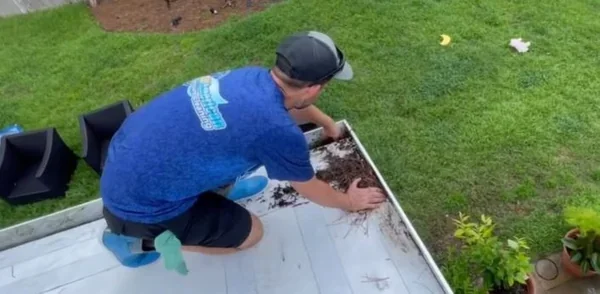
Window Wells: The Overlooked Connection Point
Window wells are supposed to keep water away from below-grade basement windows. During heavy rain, a poorly draining well can instead become a collection basin, holding standing water directly against the window seal. Once that well fills faster than it can drain — which is exactly what happens when gutter overflow or a poorly placed downspout adds extra water on top of normal rainfall — the pressure has nowhere to go but through the window.
This is one of the most common and most preventable points of basement water entry, and it’s directly tied to where your gutters are discharging, not just whether your basement itself is waterproofed.
The Four Sources of Basement Water (and Which One Gutters Cause)
Basement water generally comes from one of four places, and knowing which one you’re dealing with matters for who you call:
Hydrostatic Pressure & Window Wells
Caused by surface water — often from clogged gutters or poorly directed downspouts — building pressure against the foundation or a window well. This is the category gutter maintenance directly addresses.
Sewer or Floor Drain Backup
Water backing up through a floor drain or sewer line, unrelated to your gutters, and requiring a plumber rather than gutter service.
Above-Grade Sources
Burst pipes, failed appliances, or water heater leaks — plumbing issues with no connection to your exterior drainage.
Sump Pump Failure
A sump pump that fails or gets overwhelmed during a major storm, often compounding an existing drainage problem rather than causing it alone.
If your basement flooding tends to happen specifically during or right after heavy rain, and especially near a window well or the side of the house where a downspout discharges, gutters and drainage are the first thing worth checking.
Why Richmond’s Older Neighborhoods Face an Extra Layer of This
In parts of Richmond’s historic core, including Church Hill and the Fan District, the city’s stormwater and sewer systems share the same pipes — one of the largest combined sewer systems in the country. During heavy storms, when that combined system reaches capacity, it has less margin to spare. A home with gutters overflowing and adding uncontrolled runoff on top of an already-stressed system compounds the problem for everyone, not just the individual property. See our Richmond stormwater and your home page for the fuller picture.
What Basement Flooding Actually Costs, and What Insurance Covers
Repair costs vary enormously depending on severity. Minor clean-water cleanup can run as little as $500, while national averages for basement water damage repair tend to fall in the $3,780 to $4,500 range, and severe cases involving finished basements, mold, or structural work can run well past $15,000. Compare that to a standard gutter cleaning, which runs $150 to $550.
Cost and insurance data sourced from Forbes Home, RestoreAdvisor, and basement waterproofing industry sources, 2025-2026.
What Actually Prevents This
- Gutters kept clear enough to fully drain, especially before predicted heavy rain
- Downspouts confirmed to be flowing, not just visually checked, since a blocked downspout overflows just like a clogged gutter
- Downspout extensions that carry water several feet from the foundation, well past any nearby window wells
- Window well covers, which help independently of gutter maintenance but work best when paired with proper drainage
See our main gutter cleaning service page and our downspout cleaning and repair page for how we handle both sides of this.
Basement flooding tends to happen near a specific window or wall? Tell us and we’ll take a look at your gutters and downspouts first.
Call (804) 460-6786Frequently Asked Questions
How do I know if my basement flooding is from gutters or something else?
Timing is the biggest clue. Flooding that happens during or right after heavy rain, especially near a window well or a specific wall, points to surface water and drainage. Flooding unrelated to rain, or coming from a floor drain, points to a sewer or plumbing issue instead.
Does homeowners insurance cover basement flooding from gutter overflow?
Often, no. Standard policies frequently exclude groundwater seepage and general flooding unless you’ve added a specific endorsement. Check your policy directly, since coverage varies by insurer.
Will fixing my gutters alone stop basement flooding?
It addresses one of the four main causes. If your flooding is from surface water and downspout discharge, yes, it’s often the fix. If it’s sewer backup or a plumbing issue, gutter maintenance won’t solve it, though it’s still worth ruling out.
Are window well covers worth installing?
Yes, especially paired with proper gutter and downspout drainage. Covers alone don’t fix an overflow problem upstream, but they add a meaningful layer of protection.
Stop the Water Before It Reaches Your Basement
Gutters and downspouts that actually drain are the first line of defense against this kind of flooding.
Call (804) 460-6786 Get Free Estimate