

Ice Dams and Frozen Gutters in Richmond, VA
The real physics of how an ice dam forms, why Richmond’s version looks different than New England’s, and the honest truth about what clean gutters can and can’t fix.
The Short Answer
An ice dam forms when heat escaping into your attic melts snow on the upper roof, and that meltwater refreezes once it reaches the cold, unheated eave. In Richmond, we don’t usually get the deep, sustained snowpack that drives the classic version of this in colder climates — but a clogged gutter that traps water can freeze solid during even a single hard freeze, creating a similar blockage fast. Clean gutters help. They’re not the whole fix if your attic insulation is the real root cause.
What an Ice Dam Actually Is
According to building science research from UMass Amherst and the U.S. Department of Energy’s Building America program, ice dam formation requires three specific conditions: snow sitting on the roof, a poorly air-sealed or under-insulated attic, and freezing outdoor temperatures. When all three are present, heat escaping from the living space into the attic warms the underside of the roof deck, melting the snow layer directly above it. That meltwater runs down under the snow — much like ice floating on water in a glass — until it reaches the roof’s unheated overhang, where it refreezes into an ice ridge.
As the cycle repeats, that ridge grows into a dam that blocks further meltwater from draining. The water pooling behind it has nowhere to go but up, under the shingles, where it can leak into the attic and eventually the living space below. According to the same research, ice dams can begin forming with as little as two inches of snow on the roof.
Ice dam formation research sourced from the Building America Solution Center (U.S. Department of Energy, Pacific Northwest National Laboratory) and UMass Amherst building science research, 2019.
Richmond’s Version: Shorter Winters, Still a Real Risk
Most ice dam research is written for genuinely cold, high-snow-load climates like New England or the Upper Midwest, where sustained snow cover over weeks lets the full melt-refreeze cycle build a substantial dam. Richmond’s winters are milder, and we don’t typically hold snow on a roof long enough for that exact scenario to play out at full scale. Our average first frost lands in early November, and hard freezes tend to arrive in shorter, sharper stretches rather than weeks of continuous cold.
That doesn’t mean Richmond is exempt. A faster, more common version happens without deep snow at all: a gutter already holding water from a recent rain gets hit by a sudden hard freeze overnight, and that water freezes solid right in the trough. The next thaw sends more water down, which has nowhere to go because the frozen section is blocking it, and the cycle compounds from there — a smaller-scale version of the same basic problem, triggered by cold snaps rather than sustained snowpack.
Why Clogged Gutters Make This Worse, Even Without Heavy Snow
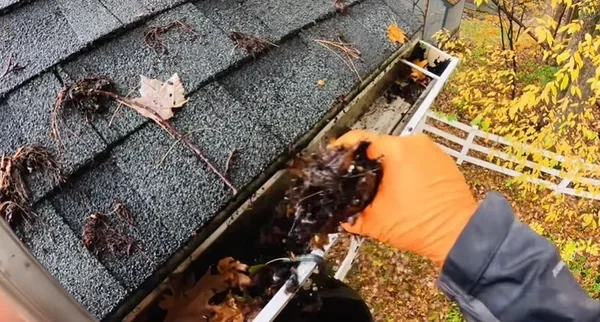
A gutter packed with leaves or pine debris holds water longer after every rain, simply because the debris slows drainage. That water sitting in the trough is exactly what turns into an ice plug the moment a hard freeze arrives. A clean, properly draining gutter empties out between rain events, which means there’s little or no standing water left to freeze when the temperature drops.
- Rain fills a debris-clogged gutter, which drains slower than it should
- A hard freeze hits before the gutter has fully emptied
- Standing water freezes solid, creating an ice plug in the trough
- The next thaw sends more water down, which backs up behind the ice instead of draining
- Repeated freeze-thaw cycles grow the ice mass, straining hangers and seams
What Ice Dams Actually Damage
- Gutters and hangers: the sheer weight of accumulated ice can strain or tear a gutter section away from the fascia entirely
- Shingles: water forced up under shingles by the dam can lift them, and repeated freeze-thaw expansion can crack or dislodge them over time
- Interior ceilings and walls: water that makes it past the shingles can show up as a ceiling stain far from where the ice dam actually formed
- Attic insulation: once water reaches the attic, wet insulation loses much of its effectiveness, compounding the heat-loss problem that caused the ice dam in the first place
The Honest Fix: Gutters Help, But They’re Not the Whole Story
We’d rather tell you this directly: a clean, well-draining gutter reduces the chance of an ice plug forming in the trough itself, and that’s a real, worthwhile step. But if your home is experiencing genuine ice dams — ridges of ice building up along the roofline itself, not just a frozen gutter — the underlying cause is almost always heat escaping from the living space into the attic. That’s an insulation and air-sealing issue, and it’s outside what gutter cleaning can fix on its own.
Not sure if what you’re seeing is a frozen gutter or a genuine ice dam? Describe it to us and we’ll tell you honestly.
Call (804) 460-6786Prevention Starts Before Winter, Not During It
The single most effective thing you can do is make sure your gutters are fully clear and draining before the first hard freeze of the season. See our fall gutter cleaning guide for timing this around Richmond’s specific leaf-drop schedule, and our guide on how often to clean your gutters to build a schedule that keeps ahead of it year-round.
Frequently Asked Questions
Is a frozen gutter the same thing as an ice dam?
Not exactly. A frozen gutter is standing water that’s frozen in the trough, often from a clogged gutter and a sudden freeze. A true ice dam forms on the roof itself, driven by attic heat loss melting snow that refreezes at the eave. They’re related and can make each other worse, but the root causes differ.
Will gutter guards prevent ice dams?
They can reduce debris that slows drainage and contributes to standing water freezing, but guards don’t address attic heat loss, which is the primary driver of a genuine ice dam. See our gutter guard installation page for what guards actually help with.
Can I remove ice from my gutters myself?
We’d caution against climbing a ladder onto an icy roofline yourself. It’s a genuinely higher-risk situation than routine cleaning, and it’s worth calling a professional rather than risking a fall.
My gutters froze and pulled away from the house. Is that repairable?
Often, yes. See our gutter cleaning and repair page for how we handle sections that have been damaged or pulled loose.
Get Ahead of the First Hard Freeze
A gutter that’s clear and draining before winter arrives is the simplest defense you have against ice damage.
Call (804) 460-6786 Get Free Estimate